
Why is this important?
Understanding if your digital health technology (DHT) qualifies as a medical device is essential for determining its regulatory pathway, market access strategy and compliance obligations under the EU medical device (MDR 2017/745) and in vitro diagnostic Regulation (IVDR (EU) 2017/746)
When Is a Technology a Medical Device?
A technology qualifies as a medical device if it meets the following criteria:
Intended Purpose
-
Diagnosis, prevention, monitoring, prediction, prognosis, treatment, or alleviation of disease
-
Diagnosis, monitoring, treatment, alleviation, or compensation for an injury or disability
-
Investigation, replacement, or modification of the anatomy or of a physiological or pathological process
-
Control or support of conception
Primary Mode of Action
Its principal intended action is not achieved by pharmacological, immunological, or metabolic means, but may be assisted by such means.
When Is a Technology not a Medical Device?
-
Its primary function is general wellness (e.g., fitness trackers, sleep monitors without diagnostic claims)
-
It is software that does not perform a medical function (e.g., administrative tools, appointment schedulers)
-
It is a consumer tool with no clinical claims (e.g., massage chairs, blue light glasses)
Borderline cases
Intended Use vs. Actual Functionality
-
Declared purpose may be advisory, but if the tool influences diagnosis or therapeutic decisions, it may qualify as a medical device under MDR Article 2
-
Borderline cases arise when tools support but do not directly drive clinical decisions — e.g., risk calculators, alerts, or triage algorithms.
Level of Automation and Clinical Judgment
-
Tools that merely present data or suggest options (e.g., dashboards, guidelines) may be exempt if they leave full interpretation to the clinician.
-
Tools that provide recommendations or prioritize actions (e.g., AI-based treatment suggestions) are more likely to be classified as medical devices.
Risk Classification Challenges
-
MDR Annex VIII introduces Rule 11, which applies to software: CDS tools used for diagnosis or therapeutic purposes often fall into Class IIa or higher, depending on risk.
-
Ambiguity arises when the tool's impact on patient management is indirect or context-dependent.
Overlap with Non-Medical Software
-
CDS tools may resemble health apps, workflow tools, or administrative software, making it unclear whether MDR applies.
-
Hybrid tools (e.g., combining clinical and operational functions) complicate classification.
Lack of Harmonized Interpretation Across Member States
-
National competent authorities may interpret MDR differently, especially for borderline software. Guidance from MDCG (e.g., MDCG 2019-11) helps, but implementation varies.
Use in Clinical Trials - Even Without MD Qualification
Even if your technology is not yet classified as a medical device, it can still be used in clinical trials to collect exploratory endpoints:
-
As an investigational device to generate evidence for future regulatory qualification
-
As a digital tool to collect endpoints or support trial operations
-
Under appropriate ethics and regulatory approvals, especially if no therapeutic claims are made
This allows innovators to validate performance, generate real-world data, and engage regulators early - without full CE marking.
Product Development & Market Access Pathway
Prototype -> Clinical Trial Use -> Evidence Generation -> CE Marking -> Market Access
What is a clinical trial endpoint?
A measurable outcome used to assess the effect of an intervention in a clinical trial. Types include:
-
Primary: Main outcome (e.g., survival rate)
-
Secondary: Additional effects (e.g., quality of life)
-
Exploratory: Hypothesis-generating (e.g., biomarker changes)
Is it a medical device?
Example - Trial endpoint scenario: Start > Data capture tool
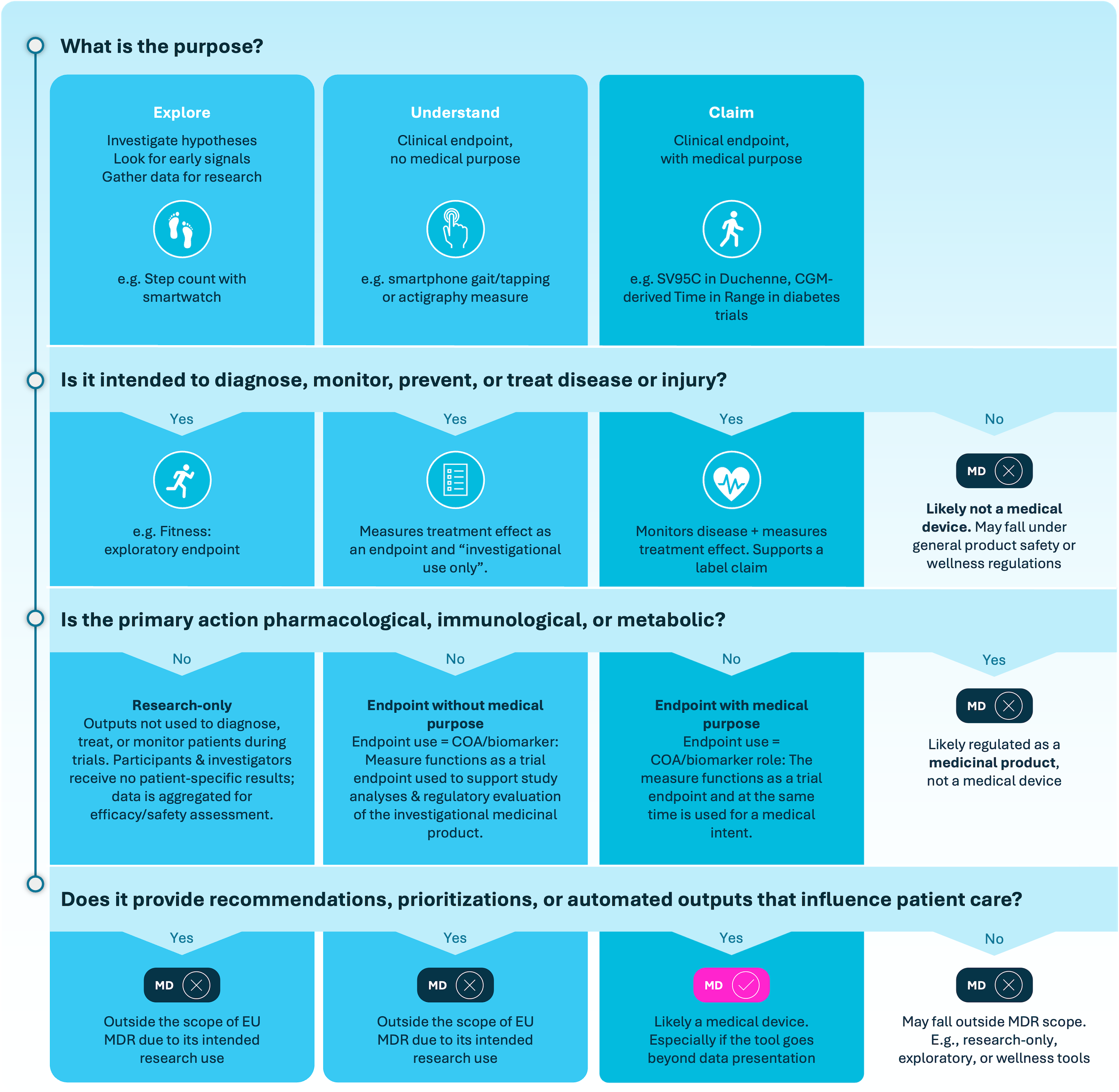
Why this is not a Medical Device (regulatory logic)?
Core principle: MDR classification hinges on the tool's intended purpose, not its technical capabilities
Intent Matters More Than Functionality
If the tool is explicitly designed for research, exploration, or hypothesis generation, and not for diagnosis, monitoring, or treatment, it falls outside MDR scope. Even if the tool processes health-related data, it's not a medical device unless it claims to influence clinical decisions.
Impact on Patient Care Is the Deciding Factor
If the tool's output does not directly inform or alter patient management, it remains outside the definition of a medical device. For example, a sensor-derived endpoint used to stratify trial populations or generate insights is not a regulated intervention.
No Clinical Claim = No MDR Classification
Tools that do not assert therapeutic or diagnostic intent - and are not marketed as such - are not subject to MDR. This includes wellness apps, behavioral trackers, and digital endpoints used solely for endpoint exploratory analysis.
Regulatory Oversight Aligns with Intended Use
Tools used in clinical trials for exploratory endpoints may fall under GxP (for primary or secondary endpoints) and general product safety - not MDR/IVDR. Regulatory pathways like DTAC or ESF may apply, but these are distinct from MDR obligations.
Validation Status Alone Does Not Determine Classification
CE marking or clinical validation may be required if the tool is intended for a medical purpose - but their absence does not automatically exclude the tool from being a medical device. Intended use remains the decisive factor: a tool without CE marking or clinical validation may still be classified as a medical device if it claims to diagnose, monitor, or treat disease.
Not sure which side of the line your DHT falls on? Borderline cases are exactly where we work. Contact us to talk to our team about your regulatory pathway and evidence strategy, before it decides for itself!
Sign up for our newsletter to receive the latest solutions, new opportunities and expert insights on digital health measures delivered to your inbox.
DEEP Measures is a collaborative technology platform and framework that helps pharmaceutical companies, technology providers, and regulators align on digital measures that are scientifically valid, clinically meaningful, and operationally ready for clinical trials. DEEP builds digital measures for pharmaceutical drug development.