.jpeg?width=924&name=Media%20(10).jpeg)
Date: May 20–21, 2026
Location: Milan, Italy
Three days in Milan, a poster session that turned into a queue and a meeting with CDISC's DHT Lead has reframed how I'm thinking about the next twelve months.
Rachid Guerchouche and I went to CDISC Europe Interchange to test a specific question:
If digital measurement concepts were CDISC-aligned at the moment they're defined (not retrofitted months later during SDTM creation), would the people who actually build and govern those standards recognise it as something worth building together?
The answer came back faster, and from higher up the org chart, than I expected. A few patterns from the leadership conversations, the training sessions and the regulatory panel are worth sharing.
.jpeg?width=800&height=1067&name=Image%20(71).jpeg)
Monica stepping into the Quark Hotel Milano kaleidoscope - with her DEEP conference shoes!
CDISC standards are the operating language of Pharma - and digital measures still don't speak it natively.
Across the conference, the same description kept surfacing from sponsors and CROs: CDISC is "the Bible" for clinical data. Embedded in submission workflows, internal tooling, vendor contracts.
AstraZeneca walked through a full NDA submission to FDA. The depth of adoption is real. The gap (and this is the point our poster makes) is that digital measurement concepts still arrive at SDTM creation without machine-actionable CDISC alignment baked in at the source. That gap shows up downstream as repeated mapping work, partial traceability for regulators, and manual translation into every new protocol.
The federated-library conversation moved from theory to a named follow-up - at the CIO/CSO level
At the CDISC 360i Information Session - the roadmap briefing for how CDISC will integrate the new biomedical concepts across SDTM, ADaM and the evolving DHT domains - the CDISC CEO, CIO and CSO were all in the room. DEEP already sits inside the CDISC DHT working group, which gave us standing for the ask. I put the question directly to the C-suite:
Would they support a federated library of biomedical concepts for digital measures, aligned with the evolving DHT standards and grounded in the mapping we presented in our poster?
The CSO was emphatic on the spot and pointed us to John Owen, CDISC's DHT Lead. The CIO followed up the next day to say she'd be in touch about requirements.
Rachid and I sat down with John Owen on Wednesday, May 20. The substantive takeaway: CDISC continually tracks grant programs and is actively looking for partners to join proposals. The next joint opportunity is expected in September 2026. Their previous proposals stalled for lack of partnering agreements - exactly the gap we are positioned to close.
Regulators are converging, not diverging
The regulatory panel - FDA, EMA, PMDA guidance overlaid in one session - landed the same message we heard at CTTC London a week earlier: the agencies are moving in step on digital evidence and data standards, and they expect sponsors to do the same.
ICH E6(R3), the evolving DHT guidance, the USDM trajectory - these are not parallel tracks. They are converging toward a world where the dossier-stage gymnastics around digital endpoints get less forgiving, not more.
-
Aligning the measurement concept to CDISC at the point of definition is the cheap version of that work.
-
Aligning it after the fact is the expensive one.
-1.jpeg?width=800&height=463&name=Image%20(73)-1.jpeg)
All the relevant CDISC standards
A word from Rachid
CDISC Milano was genuinely valuable for me. The technical depth of the presentations helped me understand the logic, the concepts and the real potential of adopting CDISC standards in what we're building at DEEP - first inside the platform itself, but also as we develop new capabilities.
We can lean on their classification standards, which are extremely familiar to the pharma world, and that would make DEEP feel immediately native to our customers. So yes, it was well worth the trip.
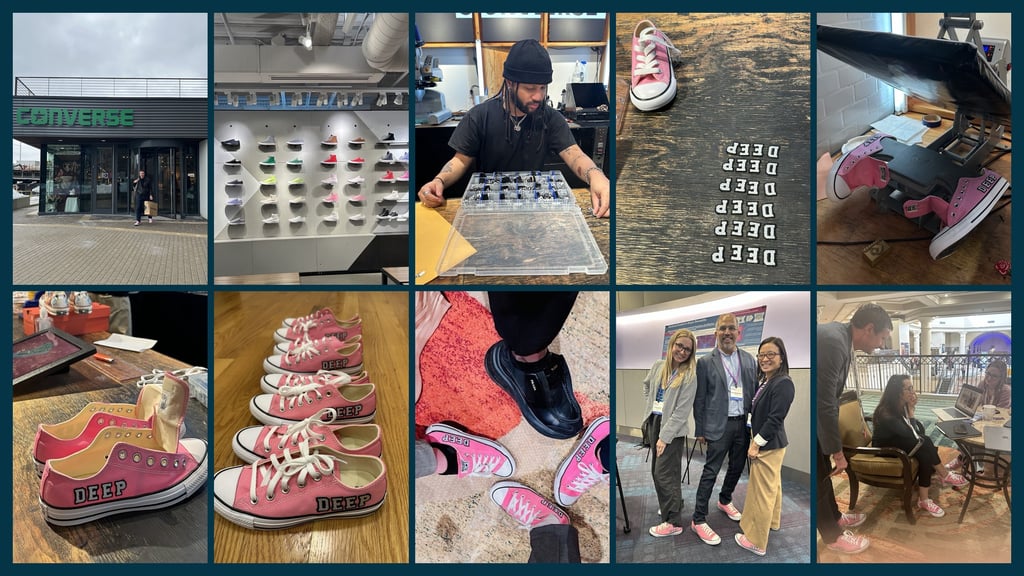
We also made ourselves nicely visible - the pink Converse did a lot of the heavy lifting there.
And on top of all that, I finally got to meet Monica face to face. I'll share more on where I see the real value in adopting these standards as I keep reflecting on it.
— Rachid Guerchouche, Science Liaison and AI Team Lead, DEEP
-1.jpeg?width=800&height=820&name=Media%20(9)-1.jpeg)
Monica and Rachid presenting DEEP's poster: Mapping the DEEP Stack to CDISC Standards: A Federated Library of Biomedical Concepts for Digital Measures.
What we're taking back
A few things I'm taking back to the team. The federated-library concept now has named CDISC owners on the other side of it — that changes what the next ninety days look like. The September 2026 grant window gives us a concrete forcing function for the joint scope, timeline and funding-breakdown conversation we need to have with CDISC SMEs first. And the breadth of pharma leads from a poster that argued for defining once and propagating everywhere — device to dataset to dossier suggests the audience for that argument is bigger than the audience for digital measures alone.
We have more to share as the follow-up conversations land — and the CDISC US Interchange in Denver this October is the next opportunity to keep the dialogue moving. For now: Milan was the right room to be in.
Monica Bali is Director, Regulatory Solutions (previously with the FDA). Rachid Guerchouche is a Science Liaison at DEEP Measures. Both were on the ground at CDISC Europe Interchange, presenting the DEEP poster (co-authored with John Batchelor). DEEP builds digital measures for pharmaceutical drug development.
The referenced poster: Mapping the DEEP Stack to CDISC Standards: A Federated Library of Biomedical Concepts for Digital Measures.
Test case: Stride Velocity 95th Centile (SV95C) in ambulatory Duchenne Muscular Dystrophy - the first wearable digital measure with EMA acceptance as a primary endpoint. Gap scorecard: 8 variables map cleanly to the CDISC DHT Portal's published SDTM pattern, 4 partially, 5 structural gaps - generating three Cnew (New Controlled Terminology) proposals ready for CDISC governance, each backed by the EMA Qualification Opinion.
Where does your team's digital-endpoint CDISC alignment break down?
That's the conversation we want. Contact us for a discussion or working session on your specific case - and if your organisation is interested in joining the federated-library proposal as a named partner ahead of the September 2026 grant window, that conversation starts now.