
Last month at an important event in Brussels, stakeholders called for a European “endpoint factory” to standardize and accelerate how novel endpoints are developed, validated, accepted, and implemented. This was in the context of the question: what more can we do to boost clinical trials in Europe?
It is the right question. New endpoints, especially digitally derived ones, can show what matters to patients in ways that clinic visits cannot. Take Duchenne muscular dystrophy: stride velocity 95th centile (SV95C), measured by a wearable in daily life, picks up decline in walking ability over shorter periods than the traditional six-minute walk test. The EMA led the way here, qualifying SV95C as a primary endpoint in 2023, the first digital measure to reach that milestone. Digital measures could also ease the burden on patients of filling in long quality-of-life questionnaires.
But today, most endpoints are still handcrafted. Each sponsor starts from scratch, evidence is rarely shared, and acceptance by regulators and HTA bodies comes late, if at all. With EU joint clinical assessments now running alongside the EMA review on tight timelines, whether an endpoint is acceptable has to be settled when the trial is designed, not at submission. The result is duplicated effort, slower trials, and slower access to medicines.
A factory works differently. It runs on a clear design, a reliable supply chain, standard parts, a shared process, quality control, and constant improvement. To be clear, a factory does not mean lowering the bar. The aim is to calibrate the evidentiary question, not the evidentiary standard: regulators and HTA bodies get the same rigor, delivered faster and more consistently. Here is how we see each station, and where DEEP contributes.
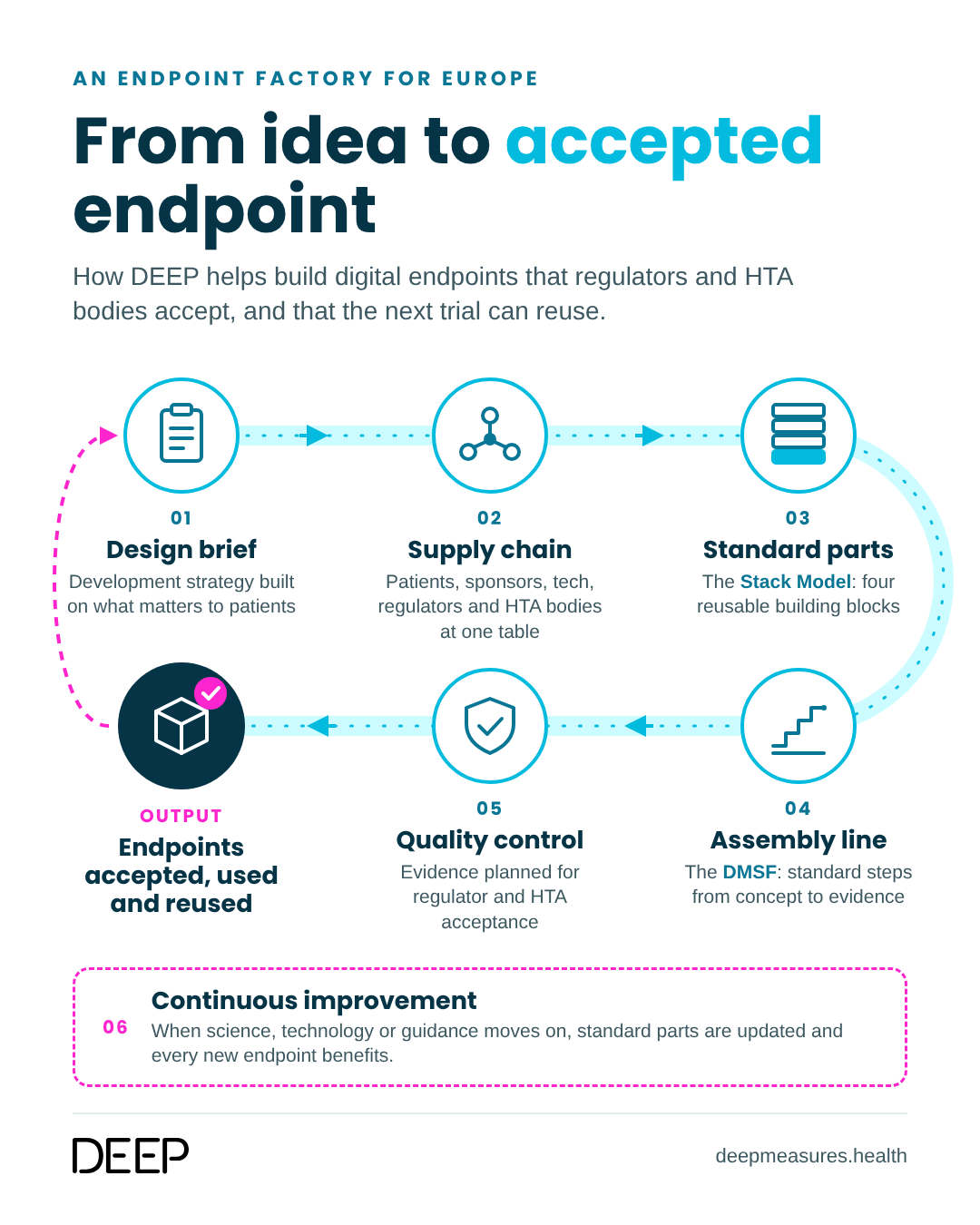
1. The design brief: a development strategy
Every good product starts with a clear specification. For an endpoint, that means starting from what matters to patients and defining the context of use: which disease, which population, which decision the endpoint will support. Getting this right first means the end product is fit for purpose from day one. Based on this information, a validation plan is developed to be executed in the next steps.
2. The supply chain: one connected network
No single organization can build an endpoint alone. It takes patients, caregivers, clinicians, academic partners, technology developers, sponsors, regulators, and HTA bodies. DEEP acts as a neutral partner or coordinator that brings these groups into the process and engine at the right time, so the right expertise and evidence arrive at the right time.
3. Standard parts: the Stack Model
Factories scale because they use standard, interchangeable parts. The DEEP Stack Model, patent-protected and peer-reviewed (Leyens et al., 2024), breaks every digital measure into four building blocks: the measurement definition, the target solution profile, the instrumentation, and the qualification protocol. Relevance, validity, reliability, and interpretability, the properties regulators and HTA bodies look for, are built into each block from the start. A block built once can be reused across diseases, devices, and sponsors, so the second program reuses components and costs a fraction of the first.
4. The assembly line: the DMSF
Standard parts need a standard process. Regulators and HTA bodies are clear about the types of evidence that can be used for validation of digital measures (e.g. clinical trial data, real-world evidence, patient preference studies, and qualitative and quantitative research). What guidance does not say is how the studies should be designed. Our Digital Measurement Strategy Framework (DMSF) fills that gap. It sets out the steps from concept to evidence, so every program follows the same proven path, and the evidence it produces is designed to be regulatory-grade and submission-ready rather than reinvented each time.
5. Quality control: built for acceptance
In a factory, quality is built by design, not inspected at the end. For endpoints, that means planning evidence around what regulators and HTA bodies need to see from the start. For HTA bodies, the real test is whether patient-relevant evidence from new endpoints becomes part of the reference case, not an appendix. At NICE, for example, the aim is for new measures to feed into the quality-adjusted life year (QALY), not to replace it. That is the hardest barrier, and it is where we focus. Our recent paper in Scientific Reports shares what we learned from a proof of concept we ran with the EMA on the qualification procedure for a digital endpoint.
6. Continuous improvement: living endpoints
Science, technology, and guidance keep moving. The EMA’s reflection paper on patient experience data, whose public consultation closed in January 2026, as well as the updated Qualification Procedure guidance, are a good example of how fast expectations are evolving. In a factory model, when a standard part is updated, the whole process is updated for future delivery and every product that goes through the process benefits. All future endpoints developed adopt the new standard. Finally, endpoints become living assets that improve over time and generate value and impact for patients, not one-off projects.
Let’s build it together
An endpoint factory for Europe will not be built by one organization. It needs regulators, HTA bodies, patients and caregivers, sponsors, technology developers, academic groups, all working to shared standards. DEEP is ready to bring its tools, its network, and its experience.
If you are working on new endpoints, or on the policy that will shape this factory, we would like to hear from you. Contact us to talk to our team.
References
Leyens et al. (2024). Expert Review of Pharmacoeconomics & Outcomes Research.
Leyens et al. (2026). Scientific Reports. Navigating the EMA qualification of novel methodologies for digital endpoints: lessons from the DEEP project proof of concept
Sign up for our newsletter to receive the latest solutions, new opportunities and expert insights on digital health measures delivered to your inbox.
DEEP Measures is a collaborative technology platform and framework that helps pharmaceutical companies, technology providers, and regulators align on digital measures that are scientifically valid, clinically meaningful, and operationally ready for clinical trials. DEEP helps builds digital measures for pharmaceutical drug development.
